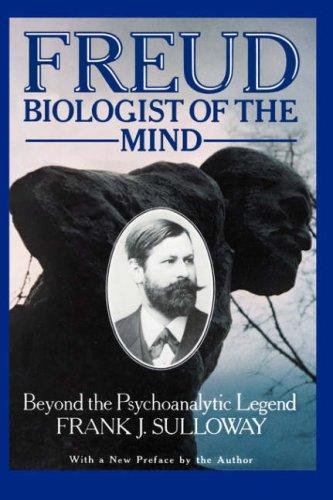
The work, which was partly inspired by the historian Henri Ellenberger's The Discovery of the Unconscious (1970), received praise, and has been credited with helping to establish the impact of biological thinking on Freud, and with being the key work that discredited psychoanalysis as science, but has also been criticized on various grounds. [...] Sulloway retraces Freud's intellectual development and places psychoanalysis in a historical context larger than that accepted by its proponents. Using sources such as Freud's personal library, Sulloway ties Freud's thinking to contemporary biological theories, and shows that Freud took care to hide the fact that his psychology was derived from neurobiology. Sulloway criticizes the "psychoanalytic legend": the idea that Freud was a lonely hero who, in a hostile intellectual climate, created ex nihilo an entirely new psychology through sheer personal brilliance and courage. Sulloway believes that such myths are sectarian propaganda and obscure Freud's real greatness. Sulloway explores in detail the influence of Richard von Krafft-Ebing, Havelock Ellis, Iwan Bloch, H. H. Ploss, Friedrich S. Krauss, Albert Moll, and Wilhelm Fliess on Freud, as well as the relation of Freud's theorizing to that of Charles Darwin. [excepted from the [Wikipedia][1] article] [1]: https://en.wikipedia.org/wiki/Freud,_Biologist_of_the_Mind
Editions · 5
Tags
Similar to this



Reviews
No reviews yet
The first word is yours.