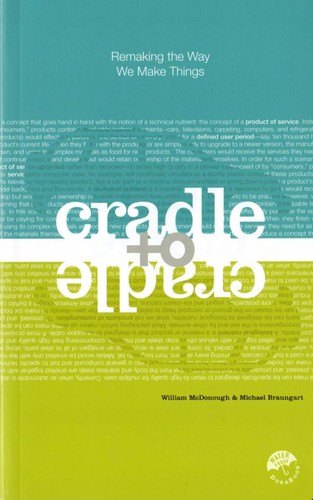
"Reduce, reuse, recycle," urge environmentalists; in other words, do more with less in order to minimize damage. But as architect William McDonough and chemist Michael Braungart point out in this provocative, visionary book, such an approach only perpetuates the one-way, "cradle to grave" manufacturing model, dating to the Industrial Revolution, that creates such fantastic amounts of waste and pollution in the first place. Why not challenge the belief that human industry must damage the natural world? In fact, why not take nature itself as our model for making things? A tree produces thousands of blossoms in order to create another tree, yet we consider its abundance not wasteful but safe, beautiful, and highly effective. Waste equals food. Guided by this principle, McDonough and Braungart explain how products can be designed from the outset so that, after their useful lives, they will provide nourishment for something new. They can be conceived as "biological nutrients" that will easily reenter the water or soil without depositing synthetic materials and toxins. Or they can be "technical nutrients" that will continually circulate as pure and valuable materials within closed-loop industrial cycles, rather than being "recycled"--really, downcycled--into low-grade materials and uses. Drawing on their experience in (re)designing everything from carpeting to corporate campuses, McDonough and Braungart make an exciting and viable case for putting eco-effectiveness into practice, and show how anyone involved with making anything can begin to do so as well.
Editions · 5
Tags
Similar to this
Nothing similar yet — this fills in as members shelve and rate more books.
Reviews
No reviews yet
The first word is yours.