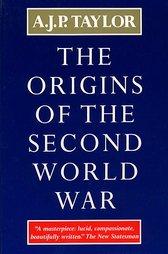
Professor Taylor has put himself way out on a limb- and his book will unquestionably continue to arouse controversy on this side of the water as it already has in what is known as the British Battle of Oxford- with Trevor-Roper as chief combatant- in England. Taylor has been accused of pro-Hilterlism, of complete reversal of his own somewhat Vansittartism in an earlier book; scholars charge him with contradictions, of failure to substantiate his statements, of a mass of unsupported wishful thinking. Germany has hailed his position with considerable glee. Now- in preface to the American edition he opens a whole new territory going back to World War I in claiming that Germany would have own had not America intervened, that American membership in the league would have been detrimental to the Allies; that the election of F.D.R. was a victory for isolation- and that if he had stood pat on this ground World War II might have been avoided; that the Nuremberg evidence was collected so that lawyers could conceal the guilt of the prosecuting powers, and so on. The legacy of Versailles was the actual cause of World War II -- and Hitler capitalized on the mistakes of the Western Powers. He was -- says Taylor- no more wicked in principle and doctrine (he makes no mention of his national excesses) than other statesmen, though he outdid them in wicked deeds. Step by step Taylor traces the march of history between the wars,- Abyssinia, the Spanish Civil War, the death of the league, the reoccupation of the Rhineland, the Sino-Japanese War, the successive immediate steps to war with the Austrian Aruchluss, the Czechoslovakian betrayal, Danzig -- and war. Throughout he sees Hitler as making no plans, as unready; he accepts Munich as a triumph of British policy which desired to deter but not provoke Hitler. France's role, too, is not presented in complimentary terms. The give and take of negotiations, to determine where the Soviet stood, kept the Western powers jittery, and ultimately Britain was caught short. Nobody wanted to go to war over Danzig, but Hitler was betrayed by his own timetable. That ultimately he attacked Soviet Russia and declared war on the United States was an accident of history- not of a madman.... Taylor's book may deal with matters of historical curiosity, but scholars will rise up to dispute him.
Editions · 5
Tags
Similar to this
Nothing similar yet — this fills in as members shelve and rate more books.
Reviews
No reviews yet
The first word is yours.